Choosing the correct steel material is one of the most important technical decisions in light gauge steel framing production.
When purchasing a light steel frame machine, manufacturers often focus on profile dimensions, machine speed, automatic size adjustment, and punching functions. However, the material thickness and yield strength of the steel coil are equally important.
A light gauge steel framing machine designed for 0.75–1.2 mm steel may not be suitable for 2.5 mm structural framing material. Similarly, a machine capable of processing G300 steel at a particular thickness may not automatically support G550 steel under the same forming conditions.
Understanding the relationship between steel thickness, yield strength, profile geometry, and roll forming capacity helps manufacturers select equipment that matches their intended building applications.
This guide explains the differences between G300, G450, and G550 steel, compares common material thickness ranges, and outlines the main factors to consider when selecting an LGS machine for high-strength galvanized steel.

What Steel Is Used in Light Gauge Steel Framing?
Light gauge steel framing commonly uses cold-formed structural steel sections manufactured from galvanized or other metallic-coated steel coils.
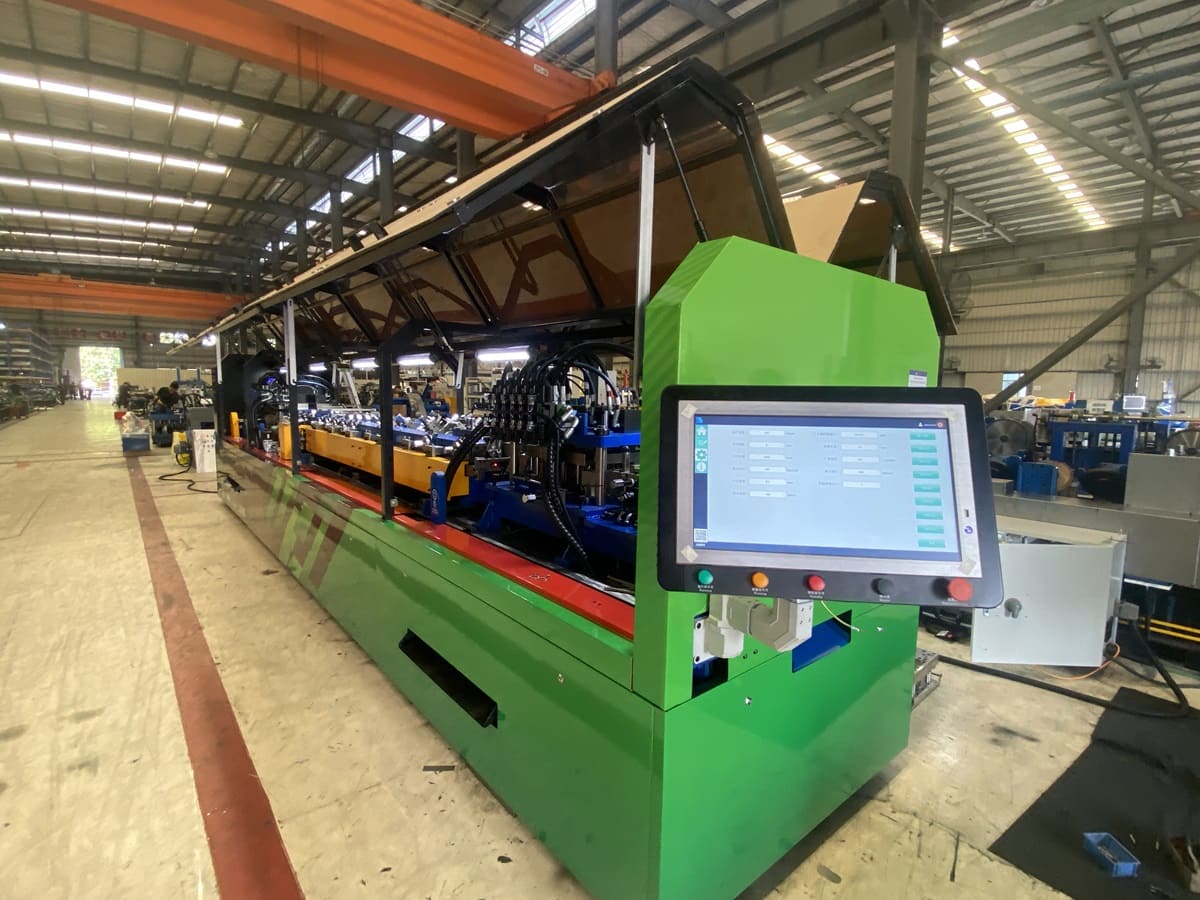
The material is processed through a steel framing roll forming machine to create components such as:
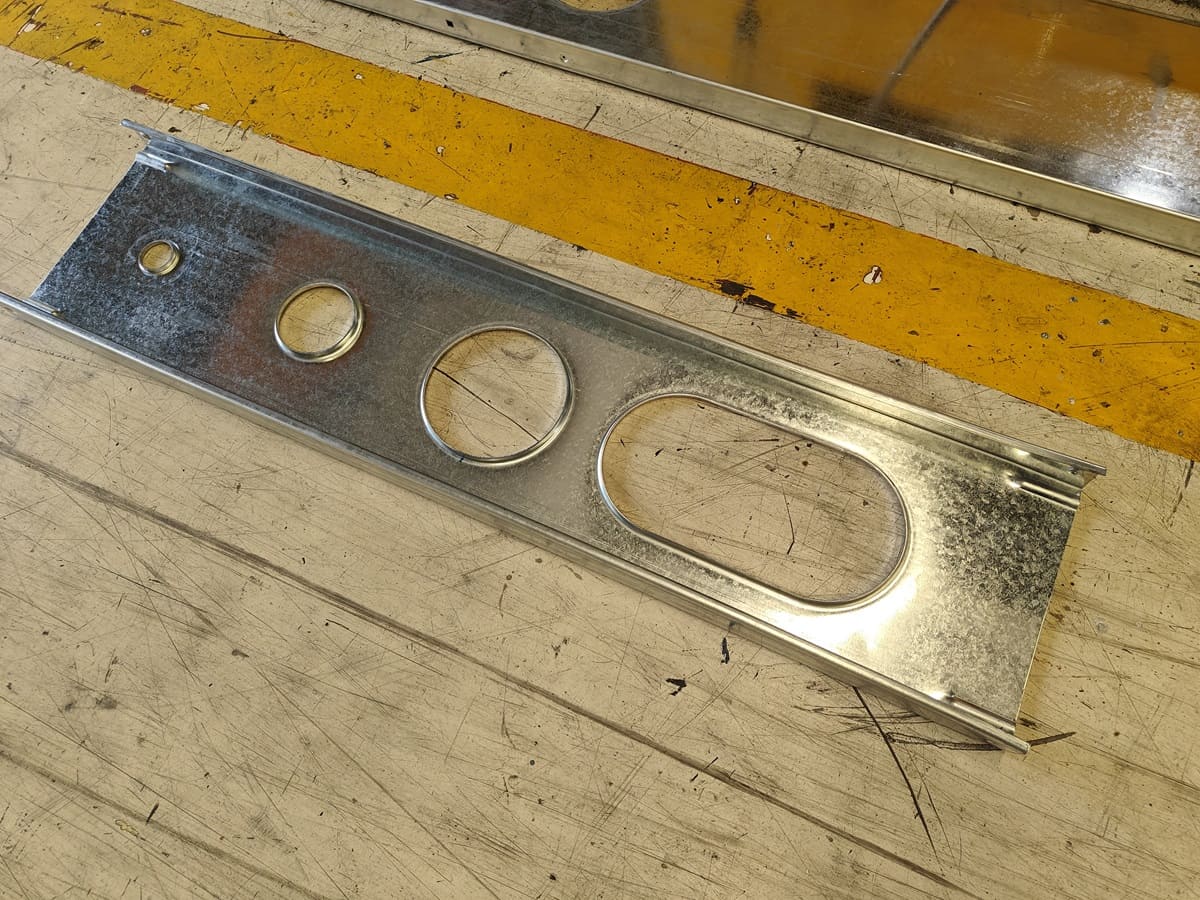
- C-shaped wall studs
- U-shaped tracks
- Roof truss members
- Floor joists
- Structural wall profiles
- Framing components for modular buildings
Different markets use different steel grades, coating designations, and dimensional standards.
For example, G300, G450, and G550 are commonly encountered grade designations in Australian and related coated structural steel specifications.
Other markets may use different material classifications, including European and North American steel grade systems.
Therefore, material selection should always refer to the applicable steel specification rather than relying only on a grade name.
What Does Steel Yield Strength Mean?
Yield strength describes the stress level associated with the beginning of permanent plastic deformation in a material under specified test conditions.
It is an important property in structural steel design and cold roll forming.
Higher yield strength can be useful in certain engineered structural members, but it may also make the material more demanding to form.
For a light steel framing machine manufacturer, this distinction matters because the forming equipment must process the material without unacceptable cracking, distortion, or dimensional inconsistency.
G300 Steel
G300 generally refers to structural steel with a specified minimum yield strength of approximately 300 MPa under the relevant grade specification.
This grade is associated with relatively good formability compared with higher-strength grades.
It may be useful for applications requiring more demanding forming operations or smaller bend radii, provided that the steel section satisfies the structural design.
G450 Steel
G450 refers to steel with a specified minimum yield strength of approximately 450 MPa.
It offers a higher nominal yield strength than G300, but typically has more limited ductility.
A steel framing roll forming machine processing G450 material must have suitable forming tooling, punching capacity, and machine settings.
G550 Steel
G550 refers to steel with a specified minimum yield strength of approximately 550 MPa.
This material is used in various cold-formed steel products, including certain structural framing systems.
However, G550 steel generally requires greater attention to bend radius, springback, tooling design, and forming conditions.
The suitability of G550 steel depends on its thickness, exact product specification, and the forming geometry.
Higher yield strength should never be treated as automatic proof that a framing member is structurally adequate.
G300 vs G450 vs G550 Steel for Light Steel Framing
| Material Property | G300 | G450 | G550 |
|---|---|---|---|
| Specified minimum yield strength | 300 MPa | 450 MPa | 550 MPa |
| Relative yield strength | Lower | Medium | Higher |
| General forming ductility | Typically better | More limited | More limited |
| Forming requirements | Often less demanding | Requires suitable tooling | Requires greater attention to tooling |
| Springback | Generally lower under comparable conditions | Can be higher | Can be higher |
| Machine compatibility | Model-specific | Model-specific | Model-specific |
These are general comparisons. Actual forming behavior depends on the steel product, thickness, metallurgical properties, coating, bend geometry, and production process.
Manufacturers should consult the material supplier’s technical data sheet and confirm equipment compatibility before production.

Why Steel Thickness Matters in Light Gauge Steel Framing
Steel thickness affects both the manufactured profile and the demands placed on the equipment.
A light gauge steel framing machine designed for relatively thin steel may use different roll forming stations, tooling geometry, drive capacity, and cutting arrangements from a heavy-duty machine.
Increasing material thickness can increase the force required for punching, cutting, and forming.
It may also influence the finished profile’s geometry and the performance of the engineered structural member.
For this reason, machine specifications usually define a supported material thickness range.
However, the advertised thickness range must be considered together with the supported steel grade and section dimensions.
Common Steel Thickness Ranges in LGS Machine Applications
0.75–1.2 mm: Lightweight Residential Framing
Light steel frame machines designed for 0.75–1.2 mm material are often associated with residential framing applications.
These may include wall studs, roof framing members, and prefabricated building components.
For example, Frametec’s SFS-C89-1.2 light gauge steel framing machine has a published material range of 0.75–1.2 mm and lists G300–G550 zinc-aluminium coated steel coils.
This machine is positioned for residential steel framing and related applications.
The actual structural application still depends on the approved member design and material specification.
0.75–1.6 mm: Flexible Residential and Modular Production
A 1.6mm light steel frame machine provides a wider thickness range than a machine limited to 1.2 mm.
This can be useful for manufacturers producing several approved framing specifications.
Frametec’s C89-1.6mm steel framing machine lists a material thickness range of 0.75–1.6 mm and G300–G550 steel grades.
Such equipment may be suitable for residential framing, prefab housing, and modular building components within its approved section and material range.
Up to 2.2 mm: Extended C-Section Production
For manufacturers requiring greater thickness capability while retaining a C-section production format, Frametec offers the SFS-C89T-2.2mm advanced light steel frame machine.
Its published material thickness range is 0.75–2.2 mm, with G300–G550 listed as the supported grade range.
This creates a broader material selection opportunity for suitable residential and structural framing applications.
Buyers should confirm whether the full range of listed steel grades can be processed at every advertised thickness and profile size.
1.0–2.5 mm: Wall and Floor Joist Manufacturing
Factories producing larger structural wall sections or floor joists may require machines designed for thicker steel.
The Frametec SFS-CU140-305 wall and floor joist machine has a published material range of 1.0–2.5 mm.
The listed material grades are G300–G450 zinc-aluminium coated steel.
Its section range of 135–305 mm makes it relevant to manufacturers producing larger C and U framing members.
A separate SFS-CU200-350 floor joist machine also lists 1.0–2.5 mm material thickness and G300–G450 steel grades.
1.0–3.0 mm: Heavy-Duty Structural Framing
Some manufacturers require larger steel sections or thicker structural materials.
For these applications, a heavy duty LGS machine may be more appropriate.
Frametec’s SFS-CC150-450 heavy duty multi profile LGS machine lists a section range of 150–450 mm and a material thickness range of 1.0–3.0 mm.
Its published material grade range is G300–G450.
This configuration is intended for larger framing sections used in suitable structural applications.
It should not be assumed that a machine rated for 3.0 mm G450 material can also form 3.0 mm G550 material.
Comparing Frametec LGS Machine Thickness Capabilities
| Machine Model | Published Thickness Range | Published Steel Grade Range | Profile / Application |
|---|---|---|---|
| SFS-C89-1.2 | 0.75–1.2 mm | G300–G550 | C-section residential framing |
| SFS-C89-1.6 | 0.75–1.6 mm | G300–G550 | Residential and modular framing |
| SFS-C89T-2.2 | 0.75–2.2 mm | G300–G550 | Extended-thickness C-section production |
| SFS-CU140-305 | 1.0–2.5 mm | G300–G450 | Wall and floor joist sections |
| SFS-CU200-350 | 1.0–2.5 mm | G300–G450 | Larger floor joist manufacturing |
| SFS-CC150-450 | 1.0–3.0 mm | G300–G450 | Heavy-duty structural sections |
Published ranges are general equipment specifications. The permissible combination of material grade, section size, and thickness must be confirmed for the exact machine configuration.
Why Higher Steel Strength Does Not Always Mean Easier Production
Buyers sometimes assume that stronger steel is automatically the better material.
In reality, steel selection involves balancing structural performance and manufacturing requirements.
A higher-strength steel may allow an engineer to consider different section designs, but it may also have more restrictive forming characteristics.
Forming Force
Higher-strength materials can require greater forming forces depending on section geometry and processing conditions.
Springback
Springback occurs when a steel section partially recovers elastically after bending.
Higher-strength steel may exhibit greater springback under otherwise comparable conditions.
The roll forming tooling must account for this behavior to achieve acceptable dimensions.
Bend Radius
High-strength steel may require larger minimum bend radii than more ductile grades.
The appropriate radius must follow the material supplier’s recommendations and the applicable forming requirements.
Punching and Cutting
Punching higher-strength material may increase the demands on punches, dies, hydraulic systems, and cutting equipment.
Profile Accuracy
A machine configured for one steel grade may require different setup conditions when processing another grade.
This is especially important when producing larger C sections, engineered floor joists, and high-strength framing components.
How Steel Grade Affects Roll Forming Quality
A steel framing roll forming machine progressively bends flat steel strip into the required profile.
The quality of the finished section depends on several interacting factors.
Steel Material Consistency
Variation in thickness, yield strength, and coil properties can affect forming results.
Roll Forming Tooling
The roller arrangement must match the intended section geometry and material characteristics.
Machine Setup
Improper setup can contribute to twisting, bowing, inconsistent flange dimensions, or other defects.
Springback Compensation
Tooling and forming adjustments may be required to achieve the intended profile dimensions.
Punching and Cutting Performance
The material must be compatible with the machine’s punching and cut-off system.
A reliable high-tensile steel roll forming process requires a suitable combination of material, tooling, machine capacity, and production control.
Galvanized Steel vs Zinc-Aluminium Coated Steel
Material selection also involves coating type.
Steel framing manufacturers commonly use metallic-coated steel to improve corrosion protection.
Two broad material categories are:
- Zinc-coated galvanized steel
- Aluminium-zinc or other specified metallic-alloy-coated steel
Different coatings may have different corrosion protection characteristics, surface properties, and handling requirements.
Coating selection should consider the environmental exposure, applicable building specification, and material supplier recommendations.
The coating designation should not be confused with the structural steel grade.
For example, G550 identifies a steel strength grade under the relevant specification, while an additional coating designation identifies the metallic coating system and coating class.
What Information Should Buyers Provide to an LGS Machine Manufacturer?
Before selecting an LGS machine, buyers should prepare a clear description of their intended products.
Important information includes:
- Required C, U, CC, or CU profile drawings
- Web, flange, and lip dimensions
- Minimum and maximum steel thickness
- Required steel grade or yield strength
- Coating type and material specification
- Punching and connection details
- Expected annual or monthly production
- Target building applications
- Applicable local construction standards
- Required manufacturing tolerances
Providing this information helps the supplier recommend a machine with appropriate forming, punching, and cutting capacity.
Common Mistakes When Selecting Steel Material for an LGS Machine
Choosing Steel Based Only on Yield Strength
Higher yield strength does not guarantee better performance for every application.
The steel grade must satisfy both engineering and manufacturing requirements.
Assuming Maximum Thickness Applies to Every Grade
A machine’s maximum thickness rating should not be interpreted independently of the steel grade and section dimensions.
Ignoring Material Formability
Even if the machine has sufficient forming force, the steel may not be suitable for the required bend geometry.
Using Inconsistent Coil Material
Variations in material properties may affect finished profile dimensions and production quality.
Selecting Equipment Before Finalizing Profile Requirements
Machine selection should follow the intended product specifications.
Choosing equipment before identifying the required steel sections may lead to unnecessary limitations or unsuitable machinery.
Frequently Asked Questions
1. What steel thickness is commonly used in light gauge steel framing?
Light gauge steel framing can use different thicknesses depending on the structural application and local construction requirements.
For example, certain residential wall framing systems may use material in the 0.75–1.6 mm range, while larger structural members or engineered floor joists may require thicker material. The correct thickness must be determined by the approved structural design rather than by a general machine recommendation.
2. What is the difference between G300, G450, and G550 steel?
The main difference is their specified minimum yield strength under the relevant steel grade standard.
G300 represents approximately 300 MPa, G450 represents 450 MPa, and G550 represents 550 MPa.
Higher yield strength can influence structural design but may also introduce more demanding forming requirements. Differences in ductility, bending performance, and springback should be considered when choosing a light steel framing machine.
3. Can an LGS machine process both G300 and G550 steel?
Some machines can process both grades within their approved operating range.
However, compatibility depends on steel thickness, profile geometry, tooling, and machine configuration. Frametec lists G300–G550 for several C89 machines, while some larger wall and floor joist machines list G300–G450. Buyers should verify the exact permitted material combinations before ordering.
4. Is G550 steel always better than G300 for steel framing?
No. G550 offers higher nominal yield strength, but that does not automatically make it the best material for every framing member.
The correct grade depends on structural design, connection requirements, section geometry, material ductility, and manufacturing capability. G300 may be more suitable for certain forming operations, while G550 may be specified for other engineered applications.
5. What happens if the steel thickness exceeds the machine’s rated capacity?
Using material beyond the approved machine capacity may cause excessive forming loads, inaccurate profiles, tool damage, punching failures, or safety risks.
Manufacturers should never assume that a machine can process thicker steel simply because it can accommodate the profile dimensions. The intended material thickness and grade must both fall within the verified operating range of the equipment.
6. Why is G550 steel sometimes more difficult to roll form?
G550 steel has higher nominal yield strength and generally more limited ductility than lower-strength forming grades.
Depending on the product specification and section geometry, it may require greater attention to tooling design, bend radius, springback, and forming conditions. The actual difficulty depends on the material thickness and desired profile rather than the grade designation alone.
7. Is a 2.5mm steel framing machine suitable for floor joists?
A machine rated for 2.5 mm steel may be suitable for certain engineered floor joist applications when it supports the required section geometry and material grade.
However, thickness capacity alone does not determine floor joist suitability. Manufacturers must also consider web depth, flange dimensions, punching functions, span requirements, and the approved structural design.
8. What is the difference between a 1.6mm and a 2.5mm light steel frame machine?
A machine rated for 2.5 mm material has a greater published maximum thickness capacity than a machine limited to 1.6 mm.
However, the two machines may also differ in supported section sizes, tooling, material grades, and intended applications. A 2.5 mm machine is not automatically better for producing small, lightweight residential profiles.
9. Does higher steel yield strength reduce the amount of steel needed in a building?
Higher yield strength can allow engineers to consider different section designs in some structural applications.
However, material savings are not guaranteed. Cold-formed steel member design can be governed by buckling, deflection, vibration, connections, or other performance requirements. The final material quantity must be determined through appropriate engineering calculations.
10. How does steel thickness affect punching tool performance?
Increasing steel thickness generally increases the demands on punching equipment.
Tooling must have suitable geometry, clearance, material properties, and available punching force. Steel strength also affects punching requirements. Buyers should evaluate the machine’s complete punching capacity rather than relying only on the advertised maximum forming thickness.
11. What steel grade should be used for European or North American construction projects?
The required grade depends on the applicable material and building standards for the project.
European and North American material designations may differ from G300, G450, and G550 terminology. Buyers should identify the exact required steel standard, grade, thickness, and coating specification before ordering materials or manufacturing equipment.
Equivalent-looking grade names should not be assumed interchangeable without verification.
12. How can Frametec help select the right machine for different steel thicknesses?
Frametec offers several light steel frame machine configurations covering different profile sizes, material thickness ranges, and published steel grades.
Buyers can provide their steel specifications, section drawings, required thicknesses, punching details, and intended building applications. This allows a comparison of suitable machine configurations and helps identify where sample material testing or additional technical verification may be necessary.
Conclusion
Selecting the correct steel thickness and yield strength for an LGS machine is essential for reliable cold-formed steel framing production.
G300, G450, and G550 steel offer different material characteristics, and each grade must be evaluated together with the required profile geometry, material thickness, and equipment capability.
A machine designed for lightweight residential steel framing may not be suitable for larger structural profiles or thicker high-strength steel.
Similarly, a heavy duty steel framing machine should not automatically be assumed to support every steel grade at its maximum thickness.
For manufacturers producing wall studs, roof trusses, floor joists, modular housing components, and heavier structural sections, careful material selection is the foundation of consistent production quality.
Explore Frametec’s light steel frame machine range to compare equipment specifications for different steel thicknesses and framing applications.
Need help selecting an LGS machine for G300, G450, or G550 steel? Contact Frametec with your profile drawings, material data, steel thickness requirements, and intended production applications to identify a suitable machine configuration.