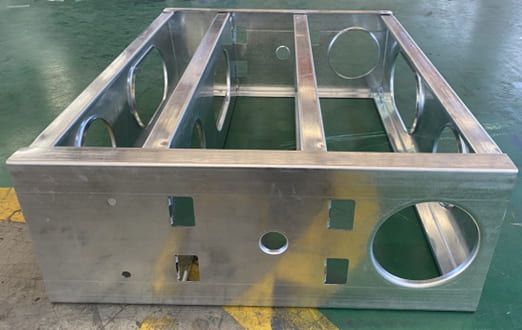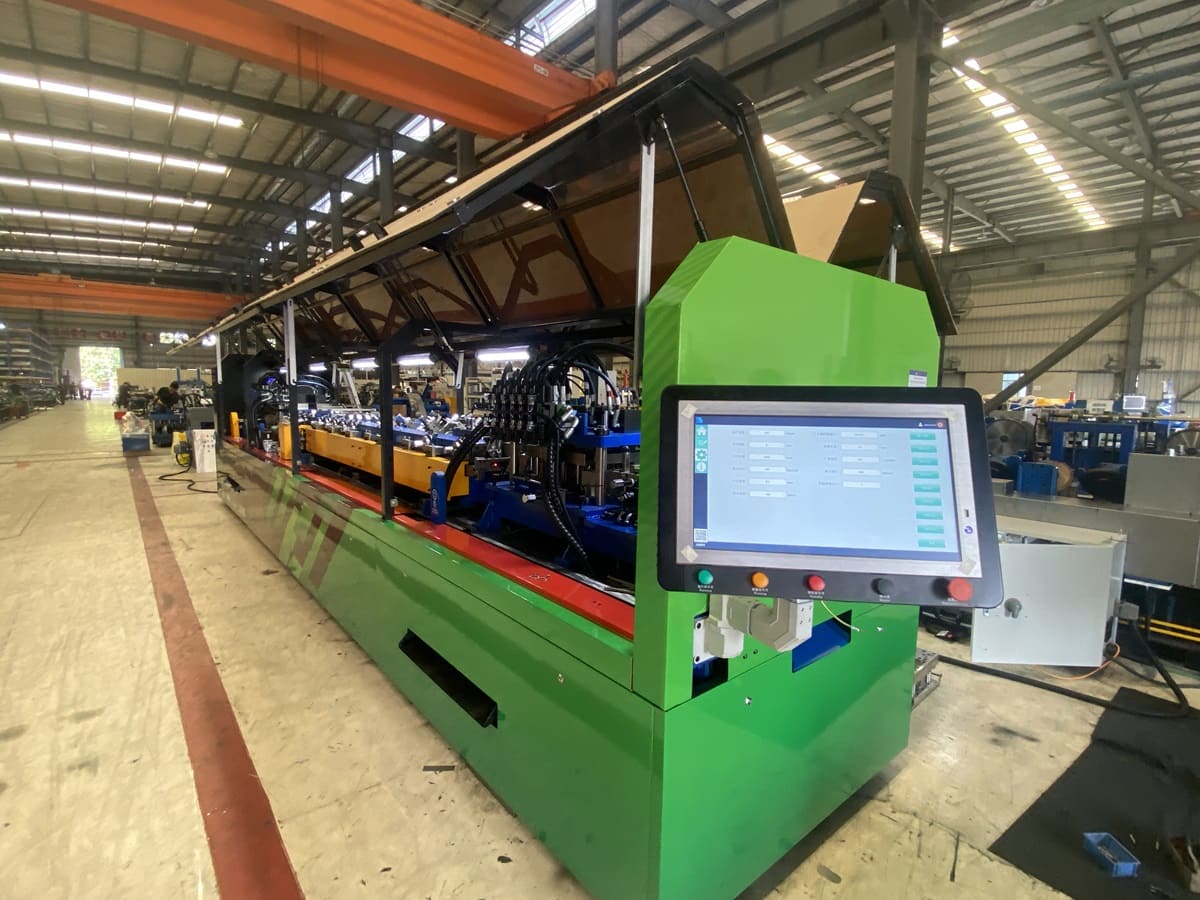
A modern light steel frame machine does much more than convert galvanized steel coils into C-shaped or U-shaped framing profiles. One of its most important capabilities is the integration of punching, notching, forming, and cutting operations within a single automated production process.
For manufacturers producing steel wall frames, roof trusses, floor joists, prefabricated houses, and modular buildings, the punching tools of an LGS machine can directly influence component accuracy, connection preparation, production efficiency, and factory assembly procedures.
Different light gauge steel framing machines may include service hole punches, web notch tools, dimple punches, lip cutters, chamfer cutters, flange cutters, fixing tab tools, and hydraulic shearing systems.
However, not every steel framing machine requires the same tooling configuration.
The correct punching system depends on the steel profile dimensions, material thickness, connection design, and the type of building components being manufactured.
This guide explains how common light steel framing machine punching tools work, what they are used for, and what buyers should evaluate before purchasing an automated steel framing production line.
What Are Punching Tools in an LGS Machine?
Punching tools are mechanical or hydraulic tooling assemblies used to create holes, openings, notches, deformations, and other features in steel framing members.
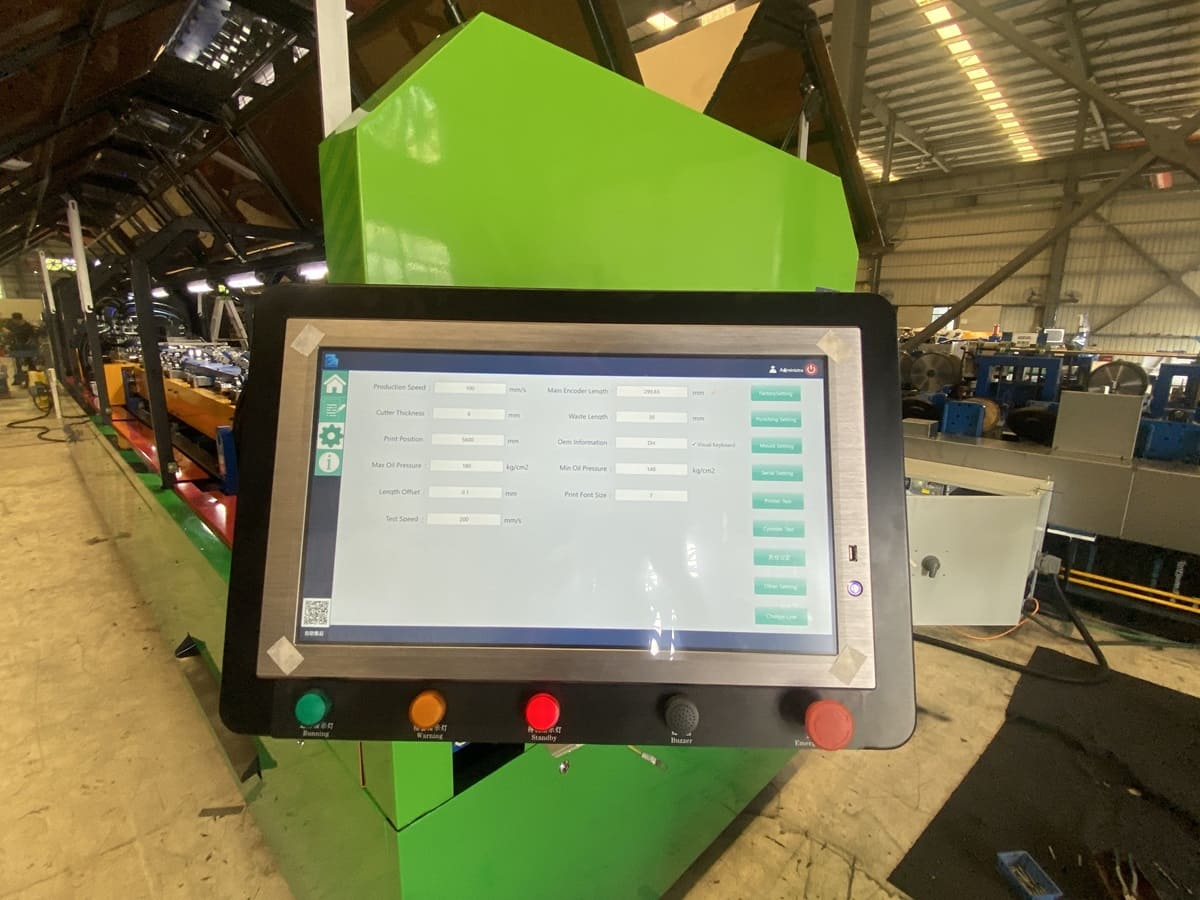
In a CNC light gauge steel framing machine, these functions are coordinated with the production control system so that each operation occurs at the required position along a steel section.
Depending on the machine design, punching may take place before, during, or after the main forming process.
A typical automatic steel framing machine may combine several operations:
- Steel coil feeding and straightening
- CNC-controlled material positioning
- Punching and notching
- Progressive roll forming
- Profile cutting
- Finished component discharge
The actual sequence varies according to machine configuration.
Integrated processing helps manufacturers reduce the need to transfer finished profiles to separate drilling, cutting, or notching stations.
More importantly, it allows the required framing features to be prepared according to the approved manufacturing design.
Main Types of LGS Machine Punching Tools
1. Service Hole Punching Tool
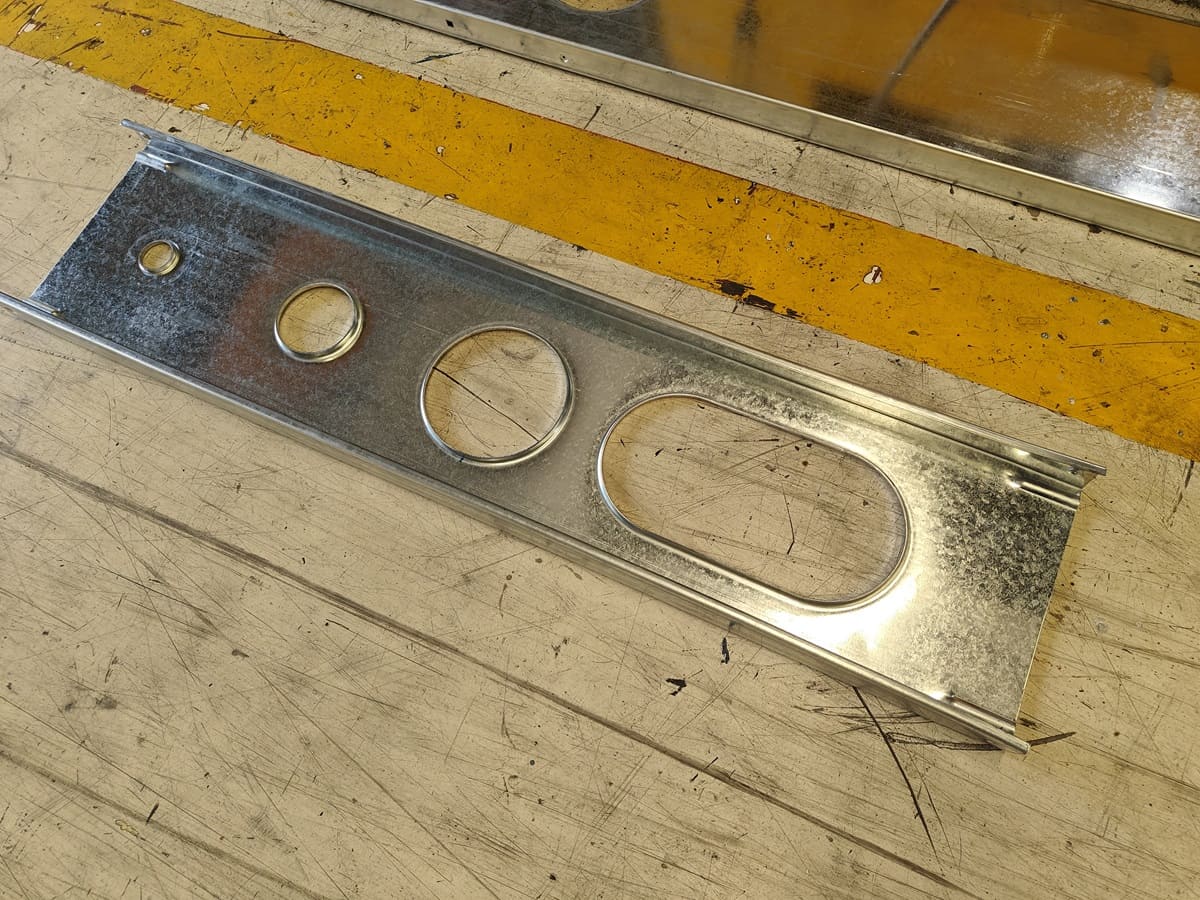
The service hole punching tool creates openings in the web of a cold-formed steel section.
These openings may be used to route approved electrical cables, plumbing pipes, and other building services through wall studs or floor joists.
Pre-punched service holes are particularly useful in prefabricated construction because service routes can be considered during the design and manufacturing stages.
In a light gauge steel framing machine, service hole dimensions and locations must correspond to the approved structural and building-services requirements.
For example, a wall stud may require a service hole at a particular position to accommodate electrical conduits. A floor joist may require a different opening layout for plumbing or mechanical services.
The service hole punch must therefore match the intended section geometry and punching schedule.
Important consideration: Not every opening is structurally acceptable. Service holes should only be manufactured in locations and dimensions permitted by the engineered framing design.
2. Web Notch Punching Tool
A web notch punching tool removes a defined portion of the web of a steel framing profile.
Web notching is commonly associated with specific framing connections, member intersections, and assembly requirements.
Unlike a service hole, which generally creates an opening within the section web, a web notch may remove material from an edge or from a connection-related area.
The exact geometry depends on the framing system.
For manufacturers producing prefabricated wall panels or roof truss members, automated web notching can reduce secondary cutting when the machine tooling matches the connection design.
However, web notches alter the cross-section of the member. Their size and position must be compatible with structural and connection requirements.
3. Dimple Punching Tool
A dimple punching tool forms a localized indentation or shaped feature in the steel section.
Depending on the connection system, dimples may assist with member positioning, screw fixing, or the fit of overlapping steel components.
Dimple features are commonly found in certain light gauge steel framing connection systems.
A properly configured dimple tool produces repeatable features with controlled depth and location.
The tool geometry, dimple position, and material deformation must match the approved connection detail.
For factories producing large quantities of wall panels, repeatable dimples can help standardize connection preparation.
4. Lip Cut Punching Tool
The lip is the narrow return edge found on many cold-formed C-shaped framing profiles.
A lip cutting tool selectively removes part of this return edge.
Lip cutting may be necessary when one framing member must fit into another or when a connection requires local clearance.
In wall framing and roof truss manufacturing, accurately positioned lip cuts can reduce manual trimming during assembly.
The cutting operation should produce a clean edge without unnecessary distortion of the surrounding section.
Because the lip contributes to the behavior of many cold-formed steel sections, lip cuts must follow the approved structural and connection design.
5. Chamfer Cutting Tool
A chamfer cutting tool produces an angled or shaped cut at a specified location on a steel framing member.
Chamfer cuts may be required for particular framing connections, member intersections, or assembly details.
For a manufacturer using a CNC steel framing roll forming machine, integrating chamfer cutting into production can reduce additional hand-cutting operations.
The important considerations include cut geometry, tooling compatibility, material thickness, and repeatability.

6. Flange Cutting Tool
A flange cutting tool removes a specified portion of the flange of a steel framing section.
Flange cuts may be required when framing members overlap, connect, or fit within a particular structural assembly.
The location of the cut must correspond to the approved production drawing.
Some advanced light steel frame machines offer additional flange cutting functions beyond the standard punching arrangement.
For example, Frametec’s SFS-C89T advanced light steel frame machine is described with flange cutting and additional forming functions.
7. Web Hole and Bolt Hole Punching
Web hole punches create specified holes within the web of the section.
Bolt hole punching tools are used where the engineered connection requires fastener holes with defined dimensions and positioning.
The required tool depends on the connection type.
A machine intended for screw-fixed residential framing may have different punching requirements from one producing components for bolted structural assemblies.
Hole diameter, edge distance, spacing, and connection strength must be established by the design.
8. Fixing Tab Punching Tool
A fixing tab tool creates a formed tab or connection-related feature in a steel framing member.
Such features can support specific framing assembly systems by providing connection geometry already prepared during machine production.
Frametec lists fixing tabs among the available punching functions of certain wall and floor joist machines.
For example, the SFS-CU140-305 wall and floor joist machine includes fixing tabs, web holes, service holes, dimples, and web notches in its published tooling information.
The suitability of a fixing tab depends on the approved connection system and the associated manufacturing geometry.
9. Swage and Specialized Connection Forming Tools
A swage tool forms a controlled local deformation that can help two steel components fit together in certain connection systems.
Some advanced steel framing machines include swage-related functions to support their specific framing connections.
Because swage geometry varies between systems, buyers should not assume that all machines use interchangeable swage tools.
Before choosing a light steel framing machine with swage capability, manufacturers should provide the intended section drawings and connection samples.
10. Hydraulic Shearing and Cut-Off Tools
Although shearing is technically a cutting operation rather than punching, it is an essential part of an integrated LGS production line.
A hydraulic cut-off system separates the finished section at the required length.
The cutting system should be evaluated for:
- Material thickness capacity
- Steel grade compatibility
- Cutting accuracy
- Burr formation
- Section distortion
- Tool wear and maintenance
A clean and repeatable cutting process is particularly important for framing members that must fit accurately into prefabricated wall panels and modular assemblies.
Comparison of Common Steel Framing Machine Punching Functions
| Tooling Function | Primary Purpose | Typical Application |
|---|---|---|
| Service hole | Create openings for approved building services | Wall studs, floor joists |
| Web notch | Remove material for specified connection geometry | Wall and roof framing |
| Dimple punch | Create localized formed connection features | Panel and framing assembly |
| Lip cut | Remove selected lip sections | Member intersections |
| Chamfer cut | Produce shaped or angled cuts | Connection preparation |
| Flange cut | Remove part of a flange | Special member connections |
| Bolt hole | Produce fastener openings | Engineered connections |
| Fixing tab | Form connection tabs | Selected wall and floor systems |
| Swage tool | Create localized forming features | Compatible connection systems |
| Hydraulic shear | Cut completed members to length | General framing production |
The exact tools available depend on the machine model and ordered configuration.
How Punching Tools Differ Between Frametec LGS Machines
Different Frametec light steel framing machines are designed for different profile dimensions and building applications.
Frametec SFS-C89 Series
The SFS-C89 light gauge steel framing machine is positioned for residential steel framing production.
Its published processing functions include dimple punching, chamfer cutting, web notching, lip cutting, service hole punching, bolt hole punching on applicable variants, and shearing.
These functions are relevant to standard residential framing, wall panels, and roof-related components.
Frametec SFS-CC75-160 Multi-Profile Series
The SFS-CC75-160 multi profile steel frame machine supports CC and CU connection systems.
It is positioned for multiple framing section sizes and includes machining functions such as dimples, chamfer cuts, web notches, lip cuts, service holes, bolt holes, and shearing.
This type of system is relevant to manufacturers producing different residential framing dimensions.
Frametec SFS-CU140-305 Wall and Floor Joist Machine
The SFS-CU140-305 is designed for larger C and U structural sections.
Its published punching functions include fixing tabs, web holes, service holes, dimples, and web notches.
This makes it relevant to manufacturers requiring specialized framing details for larger wall and floor members.
Frametec SFS-CU200-350 Floor Joist Machine
The SFS-CU200-350 multi profile floor joist machine is designed for floor joist production with sections of 200, 250, 300, and 350 mm.
Its published punching functions include fixing tabs, web holes, service holes, dimples, and web notches.
These functions support floor framing production where engineered openings and connection details are required.
Buyers should request the tooling configuration for the exact machine offered, since published product specifications do not necessarily mean every possible tool is included in every quotation.
How CNC Punching Accuracy Affects Steel Framing Quality
Punching accuracy is important because the position of holes and notches affects how framing members fit together during assembly.
Several factors influence punching results.
Material Positioning
The machine must accurately control strip movement before each punching operation.
Errors in feed positioning can lead to incorrect hole spacing.
Punch and Die Condition
Tool wear, incorrect clearance, and misalignment may affect hole dimensions and cut quality.
Steel Material Properties
Different material thicknesses and yield strengths may require changes in punching conditions.
Production Control Data
Incorrect CNC instructions can produce correctly formed holes at incorrect positions.
This is why the engineering file and manufacturing data must be checked before production begins.
Inspection and Repeatability
Manufacturers should verify hole locations, profile lengths, cut quality, and relevant dimensions using representative production samples.
Frametec publishes a punching accuracy specification of ±0.5 mm on several LGS machine pages. Buyers should confirm the measurement method, applicable production conditions, and acceptance criteria for the particular configuration.
How to Select the Right Punching Tools for Your LGS Machine
Before ordering a light steel frame roll forming machine with punching functions, manufacturers should identify their intended structural applications.
A practical tooling selection process should consider the required profiles, approved connection drawings, service openings, material grades, and production volumes.
For example, a factory focused on basic residential wall framing may require service holes, dimples, web notches, lip cuts, and standard profile cutting.
A floor joist manufacturer may place greater importance on service openings, web holes, fixing tabs, and larger structural section compatibility.
A manufacturer producing specialized modular buildings may need additional tooling for its particular connection system.
The tooling package should be selected according to actual production drawings rather than simply choosing the maximum number of available punches.
Common Problems in Automatic Steel Framing Punching
Incorrect Hole Position
Possible causes include data errors, feed positioning issues, sensor calibration problems, or incorrect material settings.
Excessive Burrs
Burrs may result from punch wear, unsuitable punch-to-die clearance, or incorrect material processing conditions.
Profile Distortion Around Openings
Distortion may occur when punching forces, tool geometry, and material properties are not properly matched.
Frequent Tool Wear
Tool wear can increase when processing harder or thicker material, especially if punch clearance and maintenance are inadequate.
Mismatch Between CNC Data and Tooling
A production file may specify a machining operation that the equipment cannot perform.
Tooling definitions should therefore be checked during the design-to-machine setup process.
Frequently Asked Questions
1. What punching tools are commonly included in a light steel frame machine?
Common LGS machine punching tools include service hole punches, web notch tools, dimple punches, lip cutters, chamfer cutters, and cutting systems.
Some machines also offer flange cutting, bolt hole punching, fixing tabs, or swage-related operations. The exact tool package depends on the machine’s intended applications and ordered configuration. Buyers should request a tooling list and sample drawings to verify that every required connection detail can be produced.
2. What is the difference between a service hole and a web notch?
A service hole generally creates an opening through the web of a cold-formed steel member to accommodate approved building services.
A web notch removes material from a defined area to create a particular connection or assembly feature. Both operations remove material and may affect structural performance. Their dimensions and positions should therefore follow the engineered design rather than being selected solely for manufacturing convenience.
3. Why is dimple punching important in light steel framing?
Dimple punching creates localized formed features used by certain steel framing connection systems.
These features may help align components or support specified screw-fixing and assembly arrangements. For factories producing repeated wall panel components, automated dimple punching can reduce secondary preparation. However, the dimple’s location, geometry, and function must match the approved connection design, and the machine must have the appropriate tooling.
4. Can a light gauge steel framing machine punch holes in G550 steel?
A machine can process G550 steel only if its forming and punching systems are rated for the relevant section size, thickness, and material specification.
G550 steel has a higher nominal yield strength than G300 steel, which can increase forming and punching demands. Manufacturers should confirm compatibility for the exact machine configuration and request sample processing using the intended coil material.
5. Does automatic punching eliminate the need for secondary drilling?
Integrated punching can eliminate some secondary drilling and cutting operations when the required holes and connection features are included in the CNC production data.
However, additional processing may still be necessary for special connections, site-specific adjustments, or details not supported by the machine tooling. The goal is to reduce avoidable secondary work, not to assume that every building connection can be completed automatically.
6. Can one punching system produce both wall and floor joist components?
Some multi profile LGS machines can process both wall and floor framing members, provided the sections and punching requirements fall within the equipment’s capabilities.
However, larger floor joists may require different hole sizes, tooling arrangements, and section support. A dedicated floor joist machine may be more appropriate when the factory produces deeper structural sections or operates a high-volume floor framing production line.
7. What causes inaccurate punching on a CNC steel framing machine?
Punching errors may result from incorrect CNC data, material feeding errors, tool wear, machine calibration problems, or improper setup.
A structured troubleshooting process should compare the original production drawing, generated CNC instructions, actual material movement, and finished sample measurements. Manufacturers should avoid adjusting tooling randomly before confirming whether the error originates from the software, positioning system, or physical punching mechanism.
8. How often should LGS machine punching tools be maintained?
There is no universal maintenance interval suitable for every tool or operating environment.
Maintenance frequency depends on the number of punching cycles, material thickness, steel grade, tool design, and production conditions. Operators should follow the machine manufacturer’s maintenance instructions and inspect tools for wear, chipping, burr formation, clearance changes, and alignment issues. Preventive maintenance is especially important when producing large quantities of repetitive framing components.
9. Are all punching functions standard on every LGS machine?
No. Punching functions vary between machine models and may also differ between standard and optional tooling packages.
For example, machines intended for basic residential framing may have a different tooling arrangement from heavy-duty wall and floor joist machines. Buyers should confirm the number of punching stations, supported operations, tool dimensions, and any optional features included in the quotation.
10. What information should buyers provide when requesting customized LGS punching tools?
Buyers should provide detailed steel profile drawings, material thicknesses, steel grades, service hole dimensions, connection details, notch geometries, required punching positions, and estimated production volumes.
It is also helpful to provide sample assembled connections or finished framing components. These documents allow the machine supplier to evaluate tooling feasibility, manufacturing sequence, punching capacity, and potential conflicts between operations.
11. How can punching tools improve modular house manufacturing?
For modular housing factories, integrated punching can prepare framing members with the holes, notches, and connection features required by the manufacturing design.
When those operations are controlled by accurate CNC data, the factory can reduce some manual preparation and improve component repeatability. This is particularly useful for standardized wall panels, floor cassettes, and roof framing assemblies produced repeatedly for modular building projects.
12. How should buyers evaluate punching tool quality before purchasing an LGS machine?
A buyer should request a demonstration using representative steel material and actual production drawings.
The demonstration should include measurement of hole positions, dimensional accuracy, cutting quality, burr formation, and repeatability across several components. It should also verify whether the machine can perform every required operation without unnecessary manual processing.
The punching tools of a light steel frame machine play an important role in transforming ordinary cold-formed steel sections into components prepared for factory assembly.
Service holes, web notches, dimples, lip cuts, chamfer cuts, flange cuts, fixing tabs, and other tooling functions each serve different manufacturing requirements.
For light steel framing manufacturers, the best punching system is not necessarily the one with the greatest number of tools. It is the one that accurately produces the features required by the intended framing system.
Frametec offers various light steel frame machines with different forming ranges and punching configurations for residential, modular, wall framing, and floor joist applications.
Planning a new steel framing production line? Share your profile drawings, material specifications, and required connection details with Frametec to evaluate an appropriate machine and punching tool configuration.